

 Go Back
Medication adherence should be a product design priority.
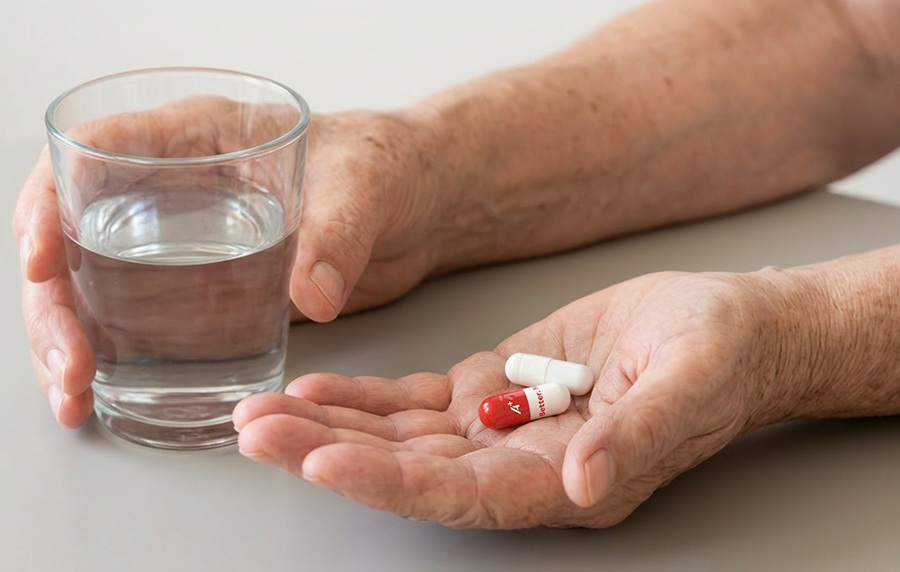
Older patients are prescribed the most pills.
The prevalence of polypharmacy (taking five or more medicines per day) among elderly patients is 45%, rising to 71% in hospital settings.2 For chronic conditions common among seniors, adherence rates for oral antidiabetics, antihyperlipidemics and antiosteoporotics are as low as 35 to 60%.3
This means that the patients with the lowest adherence across common chronic therapies are also the ones managing the highest pill burden.
A complex regimen adds cognitive burden.
The problem isn’t just that patients forget doses. They’re also managing a system that multiplies the chance of error at every step.
- Adherence rates decrease with increasing dosage frequency: from 79% at once daily to 51% at four times daily.4
- 7 in 10 patients identify their pills visually.5 With a more complex regimen and impaired vision, identifying the right pill among similar-looking ones can result in dosing errors.
By combining multiple drugs into a single pill, fixed dose combinations (FDCs) have been shown to improve adherence rates by 26%.6 However, they can introduce rework around compatibility and dose flexibility challenges, especially for APIs with different release profiles.7 Simpler tools like capsule printing, tablet embossing and colour coding can improve differentiation and reduce errors.
These interventions are not new. They address specific, known failure points. But we must view them within the context of other factors at the patient-product interface. A pill your patients recognise and remember to take is less effective if swallowing difficulties impede consistency.
Swallowing is a major hurdle even when patients remember doses.
- Around 30% of elderly patients suffer from dysphagia, rising to 58% in nursing homes.8
- Yet nearly 70% of patients report not being asked about swallowing difficulties before prescribing.9,10
As a result, up to 67% of medicines are modified (crushed or split) in geriatric care facilities.11 These changes can compromise the efficacy of modified release and enteric dosage forms.
Dosage form design is a critical point of non-adherence. Larger tablets and capsules increase oesophageal transit time, causing discomfort, gagging or even choking. Size is one of the main reasons cited for discontinuation of therapy. That’s why the FDA recommends tablets smaller than 22 mm and capsules no larger than size 00.12
Alternative designs can eliminate the need to swallow an intact tablet.
- Effervescent tablets dissolve the dose in water.
- Orally disintegrating tablets (ODTs) disintegrate in the mouth.
- Multiple unit pellet systems (MUPS) and sprinkle capsules break the dose into multiple coated pellets, which can be administered with water or soft food.
But these aren’t trivial switches. Reducing pill size requires higher-density formulations, or even reformulating altogether. They introduce significant quality and process complexity, particularly in pellet integrity13 and product stability.14
Some comparatively simpler modifications can be incorporated more readily, such as moving from uncoated to film-coated tablets or using capsules with smoother shell surfaces. Changing from round to ovular tablets can reduce cross-sectional area for easier swallowing.
These measures address dysphagia, but fall short if considered individually outside the holistic context of the patient-product interface. Because a pill your patients can swallow does no good if they can’t get it out of the package.
Packaging formats can improve adherence or obstruct access.
The package is the patient's first physical interaction with their medicine. For elderly patients with reduced grip strength and dexterity, it can be a key point of failure:
- Closure types like push-and-twist bottle caps and standard child-resistant blisters can exceed the pinch and torque capacity of elderly patients.
- With bottles, a patient unsure of whether they've taken their morning dose faces a choice between skipping or doubling.
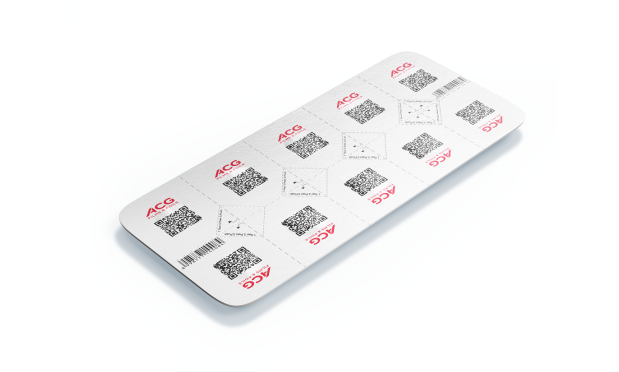
Calendar blister packs show which pockets are empty, and remove uncertainty without relying on memory. Child-resistant, senior-friendly (CR / SF) blister packs meet safety standards while reducing physical demands. However, in practice, their adoption can involve additional packaging re-design and regulatory validation, complicating standardisation across large-volume product portfolios.15
In sizable markets, there is still room to leverage simpler shifts like bottles to blister packs. In fact, studies on packaging interventions across 23,000 patients showed adherence rates of 71% with pill boxes and blister packs, compared to 63% in control groups.16
The patient-product interface should be designed for adherence.
None of these failures occur in isolation. The same patient is navigating regimen complexity, identification challenges, swallowing difficulty and packaging hurdles – often all at once.
More importantly, none of these are unsolved problems. Each has a design response that already exists at the formulation or packaging level. The gap isn’t capability, but how these decisions are made in isolation, rather than as part of a unified patient-product interface.
For product teams, this expands the development horizon from “Does this formulation meet specifications?” to “Can this patient consistently use it as intended?” That means evaluating:
- regimen complexity – how many decisions does the patient have to make each day?
- swallowability – how much physical effort does consumption require?
- accessibility – how easily can the patient handle and extract the dose?
Discussions on integrated patient usability frameworks are emerging among regulators like the FDA (US) and EMA (EU).17, 18 That’s because oral solid doses are the most widely used form globally, and also the most amenable to design-level intervention. Even marginal changes applied at scale can significantly improve real-world therapeutic outcomes.
We focus on ensuring that a molecule survives from the factory to the pharmacy, but the journey from the blister pack to the oesophagus is where adherence is won or lost. It’s time we treated the patient as the final, most critical step in the supply chain.
References:
- Cutler, R. L., Fernandez-Llimos, F., Frommer, M., Benrimoj, C., Garcia-Cardenas, V. (2018). Economic impact of medication non-adherence by disease groups: a systematic review. BMJ Open.
https://bmjopen.bmj.com/content/8/1/e016982 - Kim, S., Lee, H., Park, J., Kang, J., Rahmati, M., Rhee, S. Y., & Yon, D. K. (2024). Global and regional prevalence of polypharmacy and related factors, 1997-2022: An umbrella review. Archives of gerontology and geriatrics, 124, 105465.
https://pubmed.ncbi.nlm.nih.gov/38733922/ - Menditto, E., Cahir, C., Aza-Pascual-Salcedo, M., Bruzzese, D., Poblador-Plou, B., Malo, S., Costa, E., González-Rubio, F., Gimeno-Miguel, A., Orlando, V., Kardas, P., Prados-Torres, A. (2018). Adherence to chronic medication in older populations: application of a common protocol among three European cohorts. Patient Prefer Adherence, 12, 1975–1987
https://www.dovepress.com/adherence-to-chronic-medication-in-older-populations-application-of-a--peer-reviewed-fulltext-article-PPA#ref1 - Claxton, A. J., Cramer, J., & Pierce, C. (2001). A systematic review of the associations between dose regimens and medication compliance. Clinical therapeutics, 23(8), 1296–1310.
https://pubmed.ncbi.nlm.nih.gov/11558866/ - Sarpatwari, A., Gagne, J. J., Lu, Z., Campbell, E. G., Carman, W. J., Enger, C. L., Dutcher, S. K., Jiang, W., & Kesselheim, A. S. (2019). A Survey of Patients' Perceptions of Pill Appearance and Responses to Changes in Appearance for Four Chronic Disease Medications. Journal of general internal medicine, 34(3), 420–428.
https://pmc.ncbi.nlm.nih.gov/articles/PMC6420535/ - Bangalore, S., Kamalakkannan, G., Parkar, S., Messerli, F. H. (2007). Fixed-Dose Combinations Improve Medication Compliance: A Meta-Analysis. The American Journal of Medicine, 120(8), 713–719.
https://www.sciencedirect.com/science/article/abs/pii/S000293430601151X - Wilkins, C. A., Hamman, H., Hamman, J. H., & Steenekamp, J. H. (2024). Fixed-Dose Combination Formulations in Solid Oral Drug Therapy: Advantages, Limitations, and Design Features. Pharmaceutics, 16(2), 178.
https://www.mdpi.com/1999-4923/16/2/178 - Doan, T. N., Ho, W. C., Wang, L. H., Chang, F. C., Nhu, N. T., & Chou, L. W. (2022). Prevalence and Methods for Assessment of Oropharyngeal Dysphagia in Older Adults: A Systematic Review and Meta-Analysis. Journal of clinical medicine, 11(9), 2605.
https://pubmed.ncbi.nlm.nih.gov/35566731/ - Schiele, J. T., Quinzler, R., Klimm, H. D., Pruszydlo, M. G., & Haefeli, W. E. (2013). Difficulties swallowing solid oral dosage forms in a general practice population: prevalence, causes, and relationship to dosage forms. European journal of clinical pharmacology, 69(4), 937–948.
https://pubmed.ncbi.nlm.nih.gov/23052416/ - Strachan, I., Greener, M. (2005). Medication-related swallowing difficulties may be more common than we realise. Pharmacy in Practice, 15, 411–414.
https://www.researchgate.net/publication/289757864_Medication-related_swallowing_difficulties_may_be_more_common_than_we_realise (2005) - Clauson, H., Rull, F., Thibault, M., Ordekyan, A., and Tavernier, J. (2016) Crushing oral solid drugs: Assessment of nursing practices in health-care facilities in Auvergne, France. International Journal of Nursing Practice, 22: 384–390.
https://onlinelibrary.wiley.com/doi/10.1111/ijn.12446 (2016) - U.S. Department of Health and Human Services, Food and Drug Administration, Center for Drug Evaluation and Research (CDER). (2015). Size, Shape, and Other Physical Attributes of Generic Tablets and Capsules Guidance for Industry.
https://www.fda.gov/media/87344/download - Xu, M., Heng, P. W. S., & Liew, C. V. (2016). Formulation and process strategies to minimize coat damage for compaction of coated pellets in a rotary tablet press: A mechanistic view. International journal of pharmaceutics, 499(1-2), 29–37.
https://pubmed.ncbi.nlm.nih.gov/26748363/ - Ghourichay, M. P., Kiaie, S. H., Nokhodchi, A., & Javadzadeh, Y. (2021). Formulation and Quality Control of Orally Disintegrating Tablets (ODTs): Recent Advances and Perspectives. BioMed research international, 2021, 6618934.
https://pmc.ncbi.nlm.nih.gov/articles/PMC8719989/ - Sadamoto, K., Ura, H., Murata, M., Hayashi, M., & Kubota, K. (2023). Feasibility of Child-Resistant and Senior-Friendly Press-Through Packages: Potential of Different Materials. Pharmaceutics, 15(3), 890.
https://www.mdpi.com/1999-4923/15/3/890 - Conn, V. S., Ruppar, T. M., Chan, K. C., Dunbar-Jacob, J., Pepper, G. A., & De Geest, S. (2015). Packaging interventions to increase medication adherence: systematic review and meta-analysis. Current medical research and opinion, 31(1), 145–160.
https://pmc.ncbi.nlm.nih.gov/articles/PMC4562676/ - Food and Drug Administration. (2025). FDA Patient-Focused Drug Development Guidance Series for Enhancing the Incorporation of the Patient’s Voice in Medical Product Development and Regulatory Decision Making.
https://www.fda.gov/drugs/development-approval-process-drugs/fda-patient-focused-drug-development-guidance-series-enhancing-incorporation-patients-voice-medical - European Medicines Agency, Committee for Medicinal Products for Human Use (CHMP). (2020). Reflection paper on the pharmaceutical development of medicines for use in the older population.
https://www.ema.europa.eu/en/documents/scientific-guideline/reflection-paper-pharmaceutical-development-medicines-use-older-population-first-version_en.pdf