


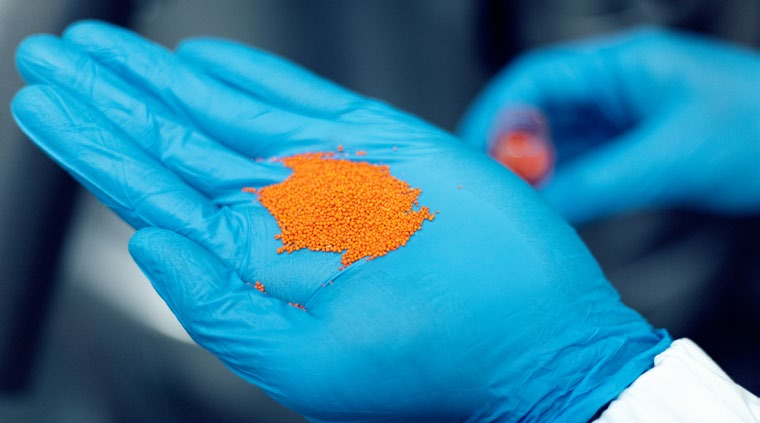

How a global CDMO cut their pellet coating time by 60%.
Recently, one of our customers (a CDMO serving regulated markets) was developing a Wurster pellet coating process for Lansoprazole Capsules.
Challenge
Wurster process constraints
To prevent nozzle clogging, the coating spray concentration was limited to 25%. However, a low concentration required lots of solvent for the same amount of drug loading.
Their material overages were capped at 5% above theoretical requirements. So, simply using more solution was out of the question. There was very little room left to optimise for efficient coating with minimal overages.
With our process engineers at ACG Laboratories, they set out to explore alternative methods.
Solution
Adopting rotor-based dry powder layering
Dry powder layering emerged as a promising option. Simultaneously spraying binder solution with API powder allowed wetting and drying phases to overlap more than conventional Wurster coating.
This minimised solution sprayed on each particle, shortening the drying time required per cycle. For more consistent pellet coating, we also attached a rotor insert to the existing fluid bed machine.
High speed rotation creates a centrifugal force. Combined with the upward air flow, particles move in a circular, helical path along the chamber walls. So spraying, drying, and mixing proceed concurrently and uniformly.
Results
60%
reduction in process time
(from 12 to 5 hours)
70%
reduction in solvent consumption
100%
reduction in material overages
(from 5% to 0%)
100%
coating efficiency
Let’s talk.
This was just one of many
stories from the ACG Laboratory
for Process Development.
If you’re developing, optimising,
or scaling up your manufacturing
process, just share your ideas with us.
We’ve got everything on site to
help you explore them.
Email us
sales.engineering@acg-world.com
Learn more
www.acg-world.com/laboratories